


I got my second COVID vaccine a few weeks ago. I’m 15, so I received the vaccine approved for the 12-15 year age group: the Pfizer-Biotech Vaccine. But today I read a piece on the CDC website saying that increased rates of myocarditis have been appearing in teens who got the vaccine. While the CDC still recommends teens getting the vaccine, as the known benefits outweigh the potential and known risks, I wondered: what is myocarditis? And why is it that getting the vaccine increases the likelihood teens will develop this condition? So I decided I’d find out. Can’t hurt to know more about this, right?
So what is myocarditis? The Mayo Clinic says it’s inflammation of the myocardium, also known as part of the heart muscle. Myocarditis can cause abnormal heart beats, also known as arrhythmias, because they decrease the ability your heart has to pump blood. Usually, a virus causes myocarditis – which is in line with the COVID-19 theory. However, myocarditis is also known to happen as a result of a more widespread inflammation condition, or as an adverse reaction to a drug.
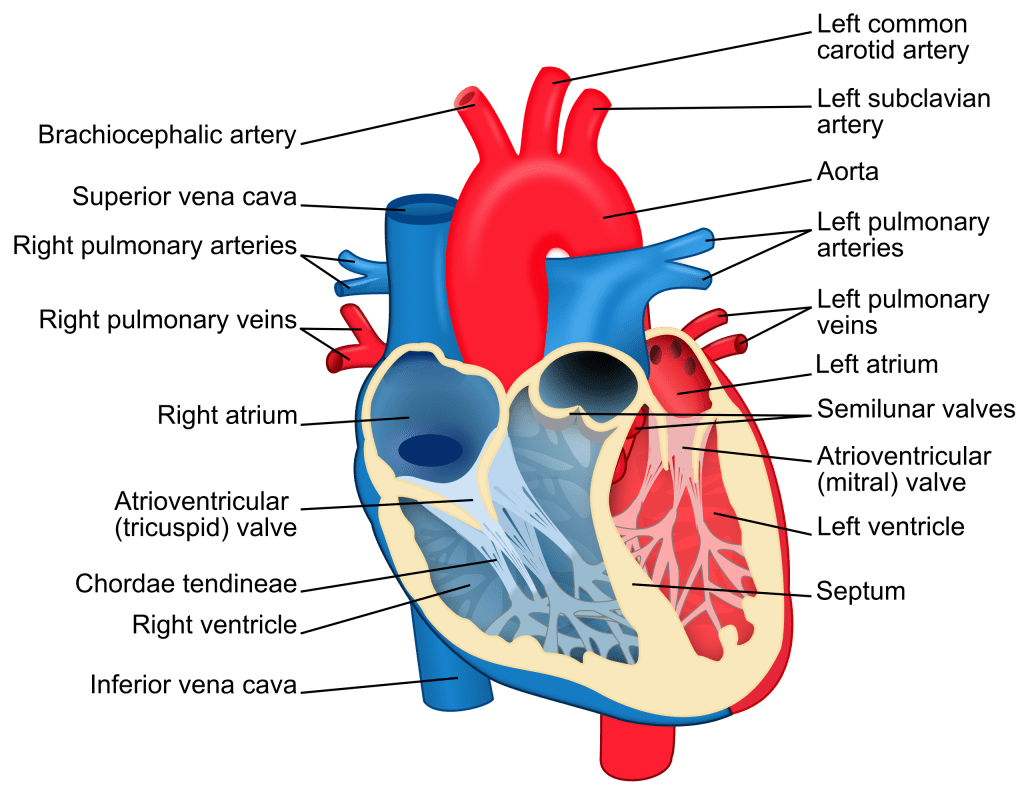
“File:Heart Diagram-En.svg.” Wikipedia, Wikimedia Foundation, 9 Oct. 2019, en.wikipedia.org/wiki/File:Heart_diagram-en.svg.
This image above is a diagram of the heart, where the red half is oxygenated blood and the blue half is deoxygenated blood. Please keep in mind that this is a diagram of the patient’s heart from your perspective, not the patient’s. From your perspective, the deoxygenated blood is on the left side of the heart, but from their perspective it’s on their right side. That’s important, because medical articles refer to the deoxygenated blood returning to the right side of the heart – which can be a little confusing! (It was for me.) The myocardium is one of the tissues that forms the heart; it’s the middle layer that consists of a lot of muscle. The other two layers are known as the epicardium (the outermost layer) and the endocardium (the layer on the inside).
So back to myocarditis – that’s just when this layer of tissue, the myocardium, sandwiched between the epicardium and the endocardium, is inflamed. Common symptoms include chest pain, shortness of breath at rest, tiredness, swelling in a patient’s ankles, legs, and feet, or symptoms of a viral infection. When it gets really serious, complications can lead to heart failure, where myocarditis is left untreated and damages your heart muscle so much that your heart can’t function right anymore. Similarly, patients might have heart attacks or strokes, because if your heart can’t pump blood properly, blood clots can form and block your arteries, leading to a heart attack. If one of those clots travels to your brain before it clogs up the artery, you can have a stroke. The Mayo Clinic says to prevent myocarditis people should avoid others who have the flu or flu symptoms and maintain good hygiene, but that there isn’t necessarily one main preventive measure (just precautions you can take).
My takeaway is that getting the COVID vaccine wasn’t a bad call; the CDC reports that patients who presented with myocarditis have responded well to medications, and with rest, their symptoms improved dramatically. More often than not, myocarditis became apparent in patients a few days after having the mRNA vaccine, with cases popping up more often with the second does than the first. These cases have only been recorded with patients who had the mRNA vaccines (Pfizer Biotech and Moderna), not the Janssen Vaccine by Johnson & Johnson. It’s been 2 weeks since I got my second dose, so I’m not too worried about getting myocarditis at this point. But if I do, I’ll rest assured that most patients respond well to medication and rest, and that if caught early, myocarditis seems to be a very treatable condition.
Now I thought I’d talk a bit about the social impacts of myocarditis. According to an article by Harvard Health, the CDC notes that for every million doses of COVID vaccines administered, 67 cases of myocarditis have been found in boys ages 12-17, and 9 in girls ages 12-17. In addition, there have been 56 cases found in men aged 18-24, versus the 6 cases found in women aged 18-24. This trend of gender is interesting- the idea that men may be more susceptible to myocarditis, due to possible genetic factors or even hormones their bodies create versus the ones females produce. As of today, 79% of adults and teens who have experienced myocarditis following administration of the COVID mRNA vaccine have recovered. I hope this was interesting/helpful to you all – I definitely thought it was good to learn about!
 History/Philosophy of Science with Gabi